


Tesla Launches the Cybercab: 2 Key Takeaways for Investors
Tesla Launches the Cybercab: 2 Key Takeaways for Investors

Lee Samaha, The Motley FoolTue, September 15, 2026 at 8:07 PM UTC
0
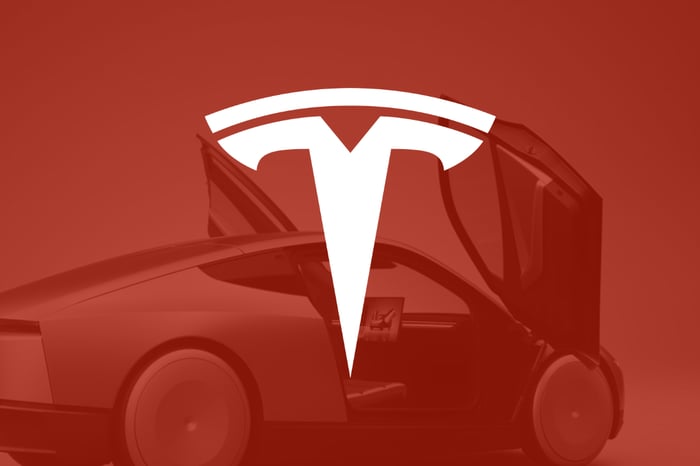
Image source: The Motley Fool.The company is making slow but measured and deliberate progress on its Cybercab/robotaxi rollout.Key Points -
Cybercab hardware is ready, but FSD software is still in development.
Tesla's cost-saving innovations could give Cybercab a decisive structural advantage in the robotaxi war.
Regulatory and production uncertainties remain significant risks.
These 10 stocks could mint the next wave of millionaires ›
Tesla's(NASDAQ: TSLA) Cybercab was a relatively low-key affair. CEO Elon Musk reportedly did not attend, and management's limited presentation left more questions than answers.
Still, in light of previous disappointments with the robotaxi rollout, in which management arguably overpromised and underdelivered, a more understated approach is probably best. However, the launch of Cybercab should excite long-term investors who are mindful of the huge potential and the risks and uncertainties ahead.
Missed AI’s "Act 1"? Act 2 Could Be 15x Bigger. Most investors think they missed the AI boat because they didn't buy Nvidia in 2005. But according to our analysts, we’re only at the end of "Act 1"—the R&D phase. "Act 2" is the global rollout. Continue »
The hardware is ready; the software is not finalized yet
While Cybercab is actively in service and production, the v15 full-self-driving (FSD) software intended to ultimately run it is not yet. A key issue for Tesla investors is that the robotaxi rollout has progressed more slowly than most expected and certainly more slowly than Musk predicted it would last year.
The key issue, as management has outlined on the last two earnings calls, is the validation and release of v15 FSD software, which is described as a "major upgrade" that will increase safety to another level. On the last earnings call in July, Tesla's head of AI, Ashok Elluswamy, said Tesla's robotaxi fleet was already running early versions of v15. Furthermore, Elluswamy noted, "We had planned roughly about seven major improvement tracks, and they're all happening in parallel. The early v15 builds running on robotaxis have already merged 40% of those tracks, and that's what's running in the fleet right now."
While the Cybercab hardware is ready, rollout and production are likely to remain relatively slow until v15 is released, something Musk thinks will happen "hopefully by the end of this year, but certainly by early next year."
Don't underestimate the importance of cost.
Cost matters a lot in a potential mass-market vehicle like the Cybercab. While Tesla's camera-only approach has, in theory, a structural cost advantage over its light detection and radar (LiDAR)-equipped rivals, it's still essential that Cybercab's costs (vehicle and cost per mile) are minimized to enable it to be able to offer rides at a massive discount to rivals like Waymo.
The good news is Cybercab's design continues to demonstrate structural cost advantages. For example:
Advertisement
Musk has confirmed its motor will not use any rare-earth materials.
Cybercab will have electric brakes rather than a complex hydraulic system and, in common with Cybertruck, will have steering by wire.
It will use a lower-cost in-house 4680 lithium-ion battery cell.
Cybercab production uses a "new reaction injection molding (RIM) process" that "reduces manufacturing cycle times from hours to just minutes, with paint injected during the molding process."
Cybercab will be manufactured using a lower-cost "unboxed" process, in which modules are built in parallel and then assembled, rather than on a linear automated production line.
The lack of a steering wheel, pedals, wing mirrors, or rear window will significantly cut costs.
While appreciating that these details may seem to be getting deep into the weeds, they are incremental details that will ensure the cost competitiveness of the Cybercab, provided it receives regulatory approval.
Image source: Tesla.How does this affect the investment case for Tesla?
Cybercab continues to face regulatory uncertainty and isn't in volume production as yet. Tesla is making progress on the v15 FSD software necessary to run it beyond the current limited commercial service, and the hard blocking and tackling to reduce costs appears to be positioning Cybercab for a structural cost advantage over Waymo and others. There's still a long way to go, but Tesla is on the right path.
Don’t miss this second chance at a potentially lucrative opportunity
Ever feel like you missed the boat in buying the most successful stocks? Then you’ll want to hear this.
On rare occasions, our expert team of analysts issues a “Double Down” stock recommendation for companies that they think are about to pop. If you’re worried you’ve already missed your chance to invest, now is the best time to buy before it’s too late. And the numbers speak for themselves:
Nvidia:if you invested $1,000 when we doubled down in 2009,you’d have $548,453!*
Apple: if you invested $1,000 when we doubled down in 2008, you’d have $63,537!*
Netflix: if you invested $1,000 when we doubled down in 2004, you’d have $433,160!*
Right now, we’re issuing “Double Down” alerts for three incredible companies, available when you joinStock Advisor, and there may not be another chance like this anytime soon.
See the 3 stocks »
*Stock Advisor returns as of September 15, 2026.
Lee Samaha has no position in any of the stocks mentioned. The Motley Fool has positions in and recommends Tesla. The Motley Fool has a disclosure policy.
Source: “AOL Money”
